How to Get Your Business Found in ChatGPT

Something changed in how customers look for you, and most businesses have not noticed yet.
Someone who needs an office cleaned used to open Google and scroll through results. Increasingly they open ChatGPT and ask, in plain language, for a recommendation. Then they take the short list it gives back and call one or two names on it.
If your business is not on that list, you never even knew the search happened. There is no impression to count, no click, and no missed-call notification, only a competitor taking the job.
Here is how businesses actually end up on that list, and the honest version of what it takes.
You cannot optimize for ChatGPT directly
The wrong idea needs clearing up first, because a growing industry is selling it.
There is no ChatGPT submission form, no paid placement inside an assistant’s recommendation, and no phrase you can embed in your homepage to make an AI prefer you. If someone offers to “register your business with ChatGPT,” they are selling nothing at all.
What AI assistants actually do for local questions is lean on the same underlying signals that power conventional map and search results. They resolve who you are by cross-referencing what the web already says about your business. The work is the local search fundamentals almost everyone skips, done properly.
What AI assistants read when they answer a local question
Four things carry most of the weight.
- Your business profile. For location-based questions, your Google Business Profile is the primary record. Categories, services, hours, service areas, and photos are structured data that determine which questions you are eligible to answer at all.
- Consistency across the web. Every directory listing your name, address, and phone number is a vote for what is true about you. When those listings disagree, an old suite number here, a disconnected phone number there, you stop being a confident entity and become an ambiguity that ranking systems route around.
- Reviews, in volume and quality. Assistants explicitly weight reputation when making recommendations. This is the part you cannot shortcut, and the part that rewards businesses that genuinely do good work.
- A fast, clearly written website. Not a beautiful one necessarily, but one that loads quickly and plainly states what you do and where you do it. Vague, clever copy is hard for a machine to quote with confidence.
Notice what is absent from that list: keyword density, backlink schemes, and most of what gets sold as SEO. The signals that matter for AI visibility are mostly signals of accuracy.
Pro tip: when you test your own visibility, ask the same question four or five different ways rather than once. “Office cleaning near me,” “commercial cleaners in [your town],” and “who should I hire to clean my office” can return noticeably different lists. One flattering result is not coverage, and one disappointing result is not a verdict.
A real example
We recently took a commercial cleaning company, Modular Concepts, from essentially no search presence to ranking first when ChatGPT is asked about office cleaning companies in Marlborough, Massachusetts. It appears pinned on the map with a 5.0 rating and, in the written recommendation, sits at number one under Best overall, ahead of considerably larger regional competitors.
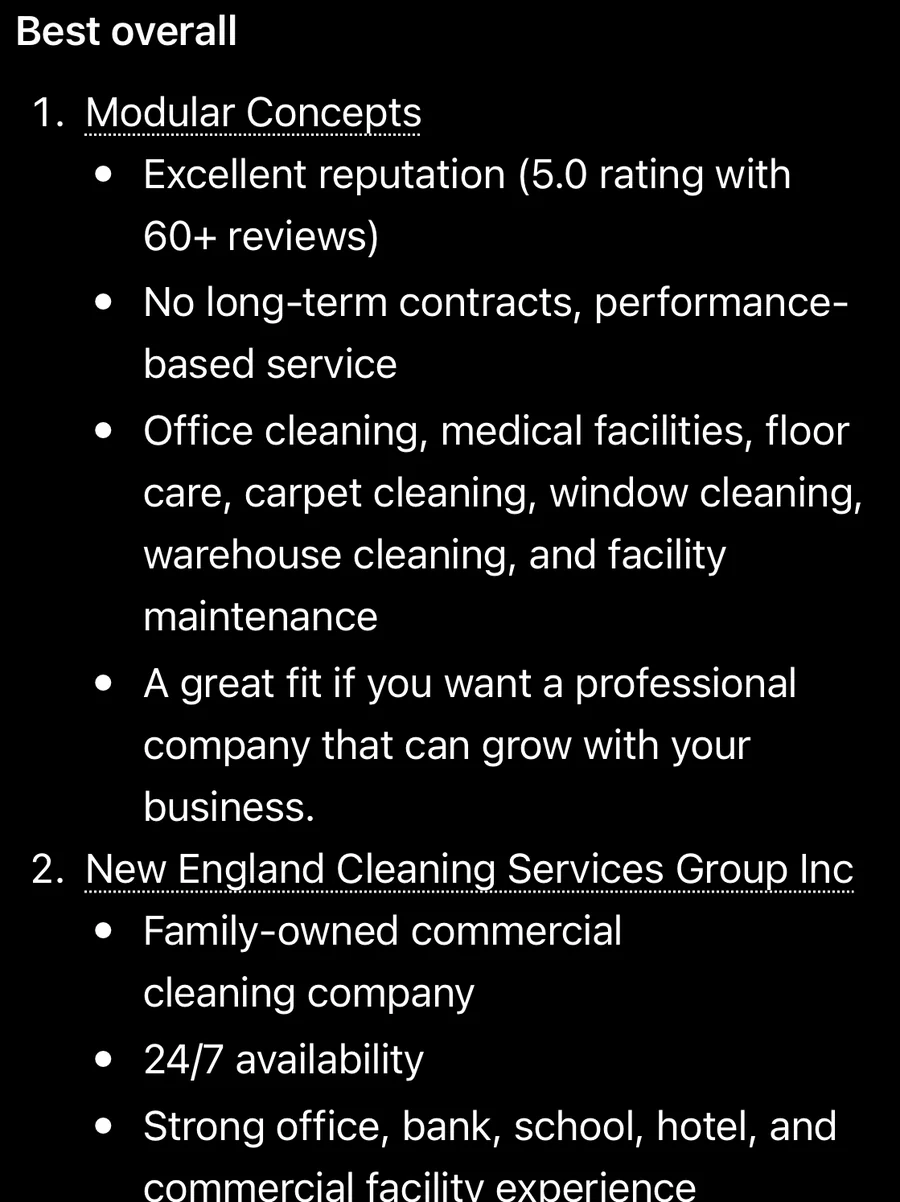
Look at what ChatGPT chose to cite: the rating and review count, the contract terms, and the range of services. All of it came from profile and listing data that had to be accurate before an assistant would repeat it back confidently.
The work behind that was deliberately unglamorous. We audited and corrected the business listings across online directories, then verified the fixes rather than assuming them. We synchronized the Google and Bing business profiles so the information stays consistent instead of quietly drifting out of date. We built a repeatable image and performance process for the website, since oversized images are the most common cause of a slow site. And we put analytics and Search Console in place so decisions came from data rather than assumption.
At no point did we optimize for ChatGPT. We fixed the underlying signals, and the AI visibility followed as a consequence.
We also ran the work itself with AI. Auditing directories, cross-checking every listing, and monitoring profiles for drift is high-value, mind-numbing work, and that is precisely the combination people abandon halfway. Running it through multi-agent orchestration is what made the boring ninety-percent-to-one-hundred-percent stretch actually get finished, which is usually where local search is won. The full case study is here if you want the detail.
The honest limitations
Three things are worth saying plainly, because the alternative is overselling.
Optimization cannot manufacture a reputation. That 5.0 rating came from doing good cleaning work for years, not from anything we did. Search work made an already-strong business findable. If the underlying service is mediocre, no amount of listing hygiene fixes that, and no honest provider should imply it will.
AI answers vary. Ask the same question twice and you may get slightly different phrasing or ordering. This is not a scoreboard with a fixed number one the way a traditional ranking is, and anyone showing you a guaranteed permanent position is misrepresenting how these systems work.
It is not instant. Listing corrections can register within weeks because they are data fixes. Reputation and ranking momentum take months. That is simply the timescale.
Where to start
If you want to know where you stand right now, do this before hiring anyone.
Open ChatGPT and ask for the kind of business you run in the town you serve. See who comes back. Then search your own business name and check whether the address, hours, and phone number that appear are actually correct everywhere they show up.
Most owners are surprised twice: once by who the assistant recommends instead of them, and once by how much incorrect information about their own business is sitting online unnoticed.
Pro tip: ask for reviews at the moment the customer is visibly happy, not in a monthly batch email. A request made right after you have finished a job well converts far better than one that arrives cold, and steady review flow matters more than a single burst, because both search engines and AI assistants read recency as evidence that a business is still operating well.
That gap is what our digital marketing services are built to close, run by the same engineers who handle managed IT and cybersecurity for our clients, which means nothing gets lost between an agency and an IT vendor blaming each other.
Book a free assessment and we will show you exactly what the internet currently says about your business, inconsistencies included, and what it would take to become the answer instead of the alternative.
Frequently asked questions
There is no submission form and no way to pay for placement. AI assistants answer local questions using the same signals that power map results: an accurate and complete business profile, consistent name, address, and phone details across directories, genuine reviews, and a fast website that plainly states what you do and where. Fix those and you become the answer the assistant reaches for.
Generative engine optimization is the practice of making a business or its content likely to be cited inside AI-generated answers, such as ChatGPT, Google AI Overviews, and Perplexity. In practice it overlaps heavily with good SEO: accurate structured data, clear factual writing, real expertise, and clean technical foundations. It is less a new discipline than a new reason to do the old one properly.
Not replacing, but supplementing, and the share is growing. People increasingly ask an assistant in plain language rather than scanning ten links, particularly for recommendation-shaped questions like finding a contractor or a cleaning company. The practical implication is that you now need to be findable in both places, and fortunately the underlying work is largely the same.
No. Unlike search ads, there is no advertising slot inside an assistant's organic recommendation. That is genuinely good news for small businesses, because it means placement is earned through data quality and reputation rather than bought by whoever has the largest budget.
Your Google Business Profile, kept accurate and complete. For location-based questions it is the primary record that search engines and AI assistants read: categories, services, hours, service areas, and reviews all determine which questions you are eligible to answer. A neglected profile is the most common reason a good local business stays invisible.
Listing and profile corrections can register within weeks because they are data fixes rather than authority building. Review momentum and ranking improvements take longer, typically a few months. Any provider promising immediate placement in AI answers is describing something that does not exist.
Written by
Andrew Wienen Founder & CEO, Prevvi
Andrew is the founder and CEO of Prevvi, a Cambridge, Massachusetts managed IT and AI solutions provider. He is Claude Certified by Anthropic and built the multi-agent AI operation Prevvi runs on, after leading enterprise AI, automation, and Workday Financials programs.
Want this handled for you?
Talk to a real engineer about your environment: no sales script, just straight answers.