Ranking First in ChatGPT for Local Search
Prevvi Team

Client
Modular Concepts, commercial cleaning
Industry
Commercial Cleaning
What was delivered
- Local SEO and citation cleanup
- Google and Bing Business Profile synchronization
- Website image and performance optimization
- Analytics and search visibility monitoring
- Generative engine optimization (AI search)
- Ongoing rank and listing quality assurance
When someone needs an office cleaned in Marlborough, Massachusetts, a growing share of them no longer open Google and scroll. They ask an AI assistant, in plain language, and take the short list it gives back.
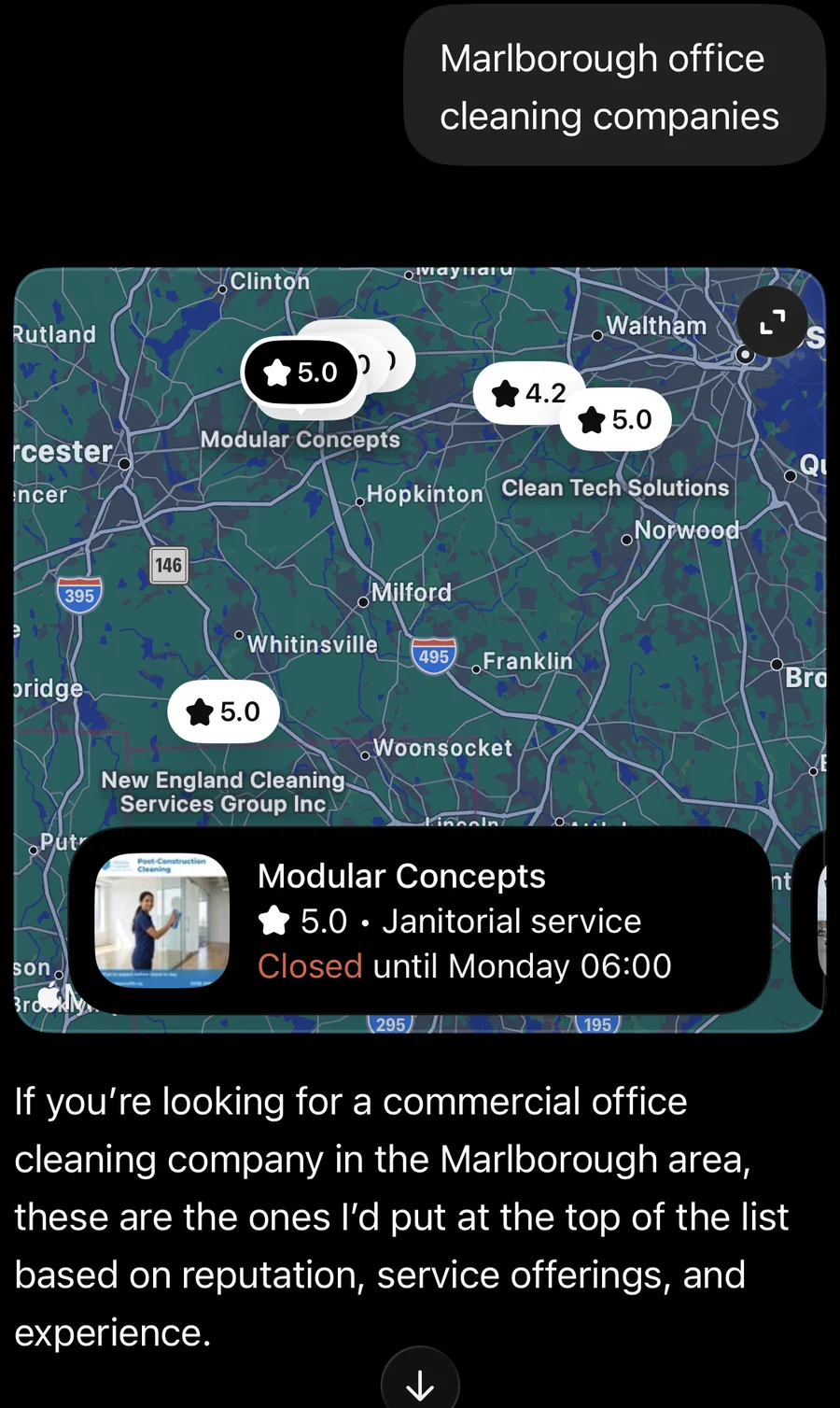
Ask ChatGPT for “Marlborough office cleaning companies” today and Modular Concepts comes back as the featured result: pinned on the map, rated 5.0, and sitting at the top of the list ChatGPT says it assembled “based on reputation, service offerings, and experience.”
That is where the company is now. It is not where it started.
The starting point
Modular Concepts is a commercial cleaning company with a real operational track record: trained crews, consistent quality, and the kind of repeat commercial contracts that only come from doing the work well. What it did not have was a digital footprint that matched.
The practical situation looked like this, and it is extremely common among well-run local service businesses:
- Business information that disagreed with itself across online directories, so no single version looked authoritative.
- Business profiles on Google and Bing that were not being actively maintained or kept in sync with each other.
- A website carrying heavy, unoptimized images that slowed pages down.
- No analytics or search monitoring, which meant no way to know which pages attracted anyone or what people searched to find them.
None of that is a reflection on the business. It is what happens when every hour goes into serving customers rather than maintaining listings. But the combined effect is that search engines, and now AI assistants, had no reliable record to draw on. The company was effectively invisible to anyone who did not already know its name.
What we did
The work broke into four connected workstreams. None of them is glamorous, and that is rather the point: local search visibility is an accumulation of unexciting things done correctly.
1. Local listing and citation cleanup
We audited where Modular Concepts appeared across online directories and found the inconsistencies: name variations, outdated contact details, addresses that did not match. Every listing was reviewed against a single canonical record of the business data, corrected through directory submissions, and then verified rather than assumed fixed.
This is the least visible work in the entire project and arguably the most important. Search engines and AI systems both resolve a business by cross-referencing what the web says about it. When those references agree, the business becomes a confident, citable entity. When they disagree, it becomes an ambiguity that ranking systems route around.
Pro tip: to find listings you have forgotten about, search your business phone number in quotation marks on Google, then do the same with any previous phone number and any previous address. Old listings rarely die, they just stop being accurate, and a disconnected number on a directory you have never heard of is quietly contradicting your real one.
2. Google and Bing Business Profile synchronization
We configured the tooling and the process to keep business information consistent across Google, Bing, and local listing platforms, so a change made once propagates rather than silently drifting out of date on a platform nobody remembers to check.
For local queries, the business profile is the record that matters most. Categories, services, hours, and service areas are the structured data that determines which questions a business is eligible to answer. Getting them accurate and keeping them accurate is the highest-leverage work available in local search.
Pro tip: your primary category carries far more weight than any secondary one. Choose the category that matches the exact words customers use, not the one that best describes your ambitions. A company that mostly cleans offices but lists itself primarily under a broader category is competing in the wrong race, and secondary categories will not rescue it.
3. Website image and performance optimization
We built a repeatable process for preparing website images rather than a one-time cleanup: resize to the display dimensions, convert to WebP, compress to one standard, strip unneeded metadata, name files descriptively, keep the originals, and write alt text.
Making it a documented process rather than a single pass is deliberate. A site optimized once degrades the moment somebody uploads a 4MB photo straight from a phone. A standard that anyone can follow keeps the gains.
Pro tip: resize before you compress. A photo saved at 4000 pixels wide but displayed in a 800 pixel column is sending roughly twenty-five times the pixel data the visitor will ever see, and no compression setting recovers that. Resize to the actual display width first, then convert to WebP, and the file usually shrinks by more than ninety percent before quality settings even enter the conversation.
4. Analytics and search visibility monitoring
We implemented Google Analytics and Search Console, set up rank tracking, and established ongoing review of landing pages, engagement, local search performance, and conversion patterns.
This converted the work from guesswork into a feedback loop. It became possible to see which services drew traffic, which pages attracted attention and which were ignored, and where the next round of effort should go.
The result
Ask ChatGPT for “Marlborough office cleaning companies” and Modular Concepts comes back pinned on the map as the featured business, rated 5.0, alongside considerably larger regional competitors.
Scroll into the written recommendation and the position is explicit. Under Best overall, Modular Concepts is listed first, cited for its 5.0 rating across 60 or more reviews, its no-long-term-contract model, and a service range spanning office cleaning, medical facilities, floor care, carpet and window cleaning, warehouse cleaning, and facility maintenance.
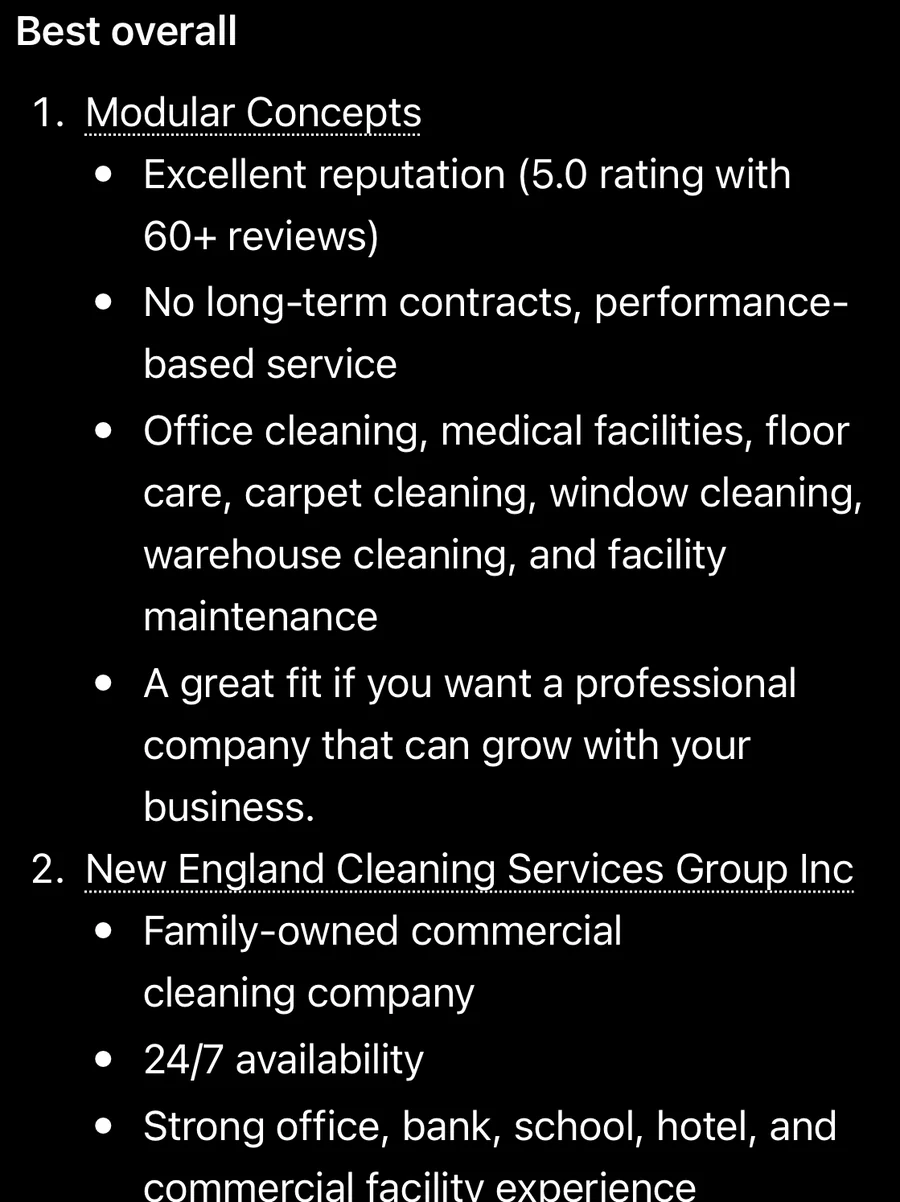
Look at what ChatGPT chose to cite: reputation, contract terms, and service breadth. Every one of those came from profile and listing data that had to be accurate and complete before an assistant could repeat it back with confidence.
It is worth being precise about what produced that outcome, because it is the most useful part of this story: we never optimized for ChatGPT. There is no setting to submit a business to an AI assistant, and anyone selling one is selling nothing.
What AI assistants do is lean on the same underlying signals that power conventional local search: an accurate and complete business profile, consistent information across the web, real reviews, and a site that clearly communicates what the business does and where. Those signals were fixed methodically. The AI visibility followed as a consequence.
That is the whole insight. Generative engine optimization, as an industry is now calling it, is mostly local SEO fundamentals executed properly, plus content structured clearly enough for a machine to quote confidently. We wrote up the mechanics separately in how to get your business found in ChatGPT, including how to check where you currently stand.
How the work was actually run
One more thing separates this from a conventional agency engagement, and it is the reason the tedious parts got finished rather than abandoned at ninety percent.
We ran it with AI orchestration. Auditing directories, cross-checking every listing against a canonical record, flagging the disagreements, monitoring profiles for drift, and watching rank and engagement data are all work that is enormously valuable and profoundly boring. That combination is exactly what gets skipped by humans and exactly what multi-agent orchestration handles well: many small verification tasks, run in parallel, consistently, without the attention decay that makes a person stop checking listings at item forty.
What that changes in practice is not speed so much as completeness. The stale listing on the obscure directory, the profile field that quietly reverted, the page that lost traffic last month, these are the things a person misses and a well-built system does not. Judgment stayed human throughout: which categories to target, what the copy should say, how to interpret the data. The relentless checking is what we automated.
This is the same practical approach behind our AI and automation services, and it is why our digital marketing work is run by engineers rather than account managers. Prevvi is also Claude Certified by Anthropic, so the AI tooling behind this work is backed by verified skill rather than enthusiasm.
Why it worked
Three things mattered more than any tactic.
The business was genuinely good first. A 5.0 rating across a substantial review base is not something search work manufactures. Optimization made an already-strong operation findable. It cannot invent a reputation that the work does not deserve, and no honest search engagement should claim otherwise.
The unglamorous work was actually finished. Citation cleanup is tedious and easy to leave at ninety percent. The last ten percent, the stale listing on the directory nobody has thought about in years, is frequently the one contradicting everything else.
Measurement came before optimization. Analytics and Search Console were implemented early, so decisions afterward were informed by what was actually happening rather than by assumption.
What this looks like for another business
The pattern generalizes to essentially any local service business: audit the listings, fix and synchronize the profiles, make the site fast and clearly written, instrument everything, then keep it maintained. There is no secret step. The difficulty is that it requires sustained, careful attention to details that produce no immediate visible reward, which is exactly why most businesses skip it and why doing it well remains a genuine advantage.
If customers are finding your competitors when they ask an AI assistant for a recommendation, the gap is rarely the quality of your work. It is usually the quality of the data the internet holds about your work. That is as true for a law firm or a biotech as it is for a cleaning company, which is why this same sequence runs behind most of our work across Greater Boston.
That is the problem our digital marketing services exist to fix. Book a free assessment and we will show you exactly what the web currently says about your business, inconsistencies included.
Frequently asked questions
You do not optimize for ChatGPT directly. AI assistants answer local questions by leaning on the same underlying signals that power map results: an accurate, complete business profile, consistent business information across directories, genuine reviews, and a fast website whose content plainly states what you do and where you do it. Fix those and you become the answer AI tools reach for.
A citation is any place online that lists your business name, address, and phone number. When those listings disagree, for example an old suite number on one directory and a disconnected phone number on another, search engines lose confidence in which version is correct. Citation cleanup audits every listing, corrects the inconsistencies, and verifies the fixes stuck.
For location-based queries, the business profile is the primary record search engines and AI assistants read. Categories, service lists, hours, service areas, photos, and reviews all feed how and whether you appear. A neglected profile is the single most common reason a real, well-run local business stays invisible.
Listing and profile corrections can register within weeks because they are data fixes rather than authority building. Ranking and review momentum take longer, typically a few months, because they depend on accumulated trust signals. Anyone promising immediate top placement is selling something other than search work.
Yes. Page experience is a documented ranking input, and oversized images are the most common cause of a slow site. Resizing, converting to modern formats like WebP, compressing, and naming files descriptively improves both load time and the context search engines have for your pages.
Often more easily than in traditional search. AI assistants weight relevance, review quality, and data accuracy heavily for local questions, and those are things a focused local operator can genuinely win. A well-maintained profile with strong reviews frequently outranks a larger competitor that neglected its listings.
Have a similar project in mind?
Talk to a real engineer about your environment: no sales script, just straight answers on how we would approach it.